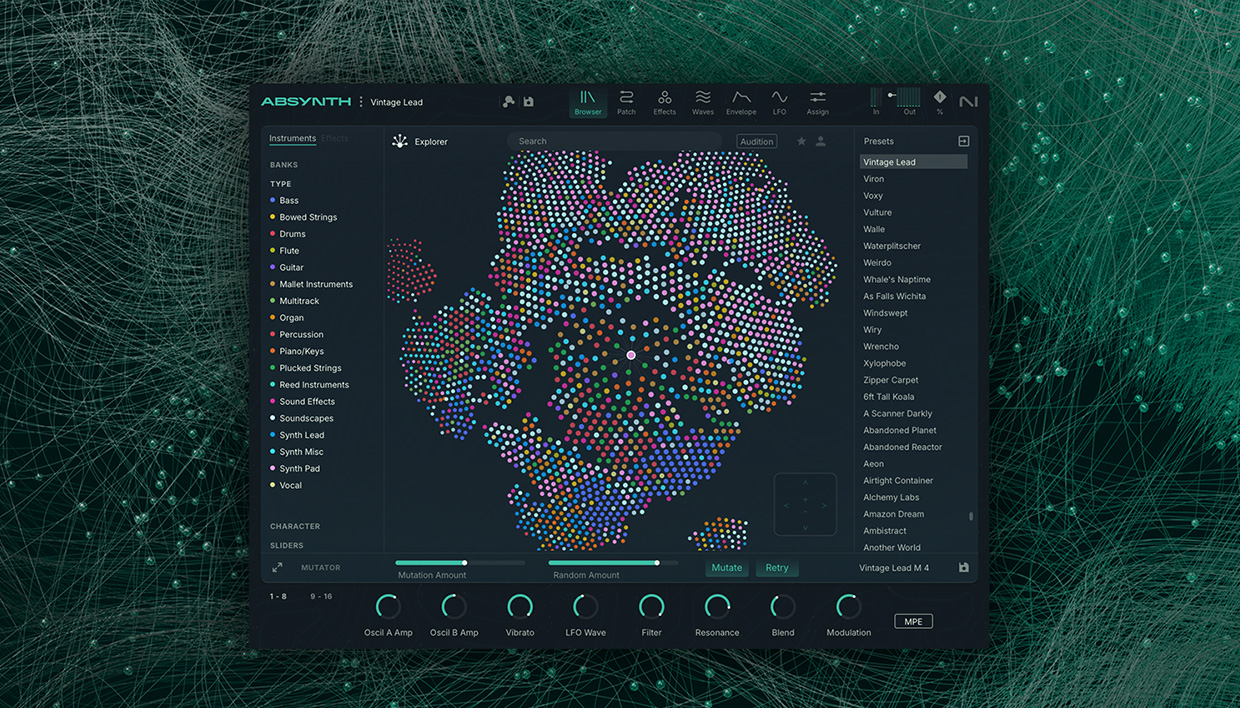
Absynth has an enormous preset library, and for most of its life the only way in was a list of names. Names are a poor index for sound: they tell you what someone called a patch, not what it does. The Preset Explorer replaces the list with a map, where position means something: presets sit near the sounds they resemble.
I worked on this from the early research prototypes through to the shipped feature, on the audio analysis and preset organisation, and on the spatial and kinetic logic that turns that analysis into something you can move through.
Listening instead of generating
The analysis extracts each patch’s perceptual character (brightness, sustain, noisiness and related qualities) and uses it to place the patch. Nothing here generates audio. As the article puts it, rather than using AI to generate sound, we use it to listen: analysing and organising presets to reveal relationships that already exist in the library.
That distinction is the whole design. The system does not decide what you should play. It arranges what is already there so that your ear can do the deciding.
A space with physics
Presets behave as particles: each is drawn toward its own sonic coordinates while pushing away from its neighbours. Similar sounds settle into clusters, contrasts open up as gaps, and the structure of the library becomes visible rather than alphabetical. Moving through it with the mouse or the keyboard, with an audition mode for fast previewing, turns browsing into listening. Filters narrow the field in real time as your intent sharpens.
Absynth’s creator Brian Clevinger described the effect as removing language from the search process. Music and language, as he put it, usually occupy different parts of the mind.
Why it matters to me
Most of my research is about giving musicians control over models rather than outcomes from them. This is the same argument in a product: AI used for navigation, orientation and agency, not for automatic generation. It is also the first piece of my work at Native Instruments that shipped to players rather than to a paper.
Credits
- Role
- Research engineering: audio analysis, preset organisation, and the spatial and kinetic logic behind the map
- With
- Eric Oake Product Design, interaction prototyping Hannah Lockwood Lead Product Design
- Support
- Built with the Native Instruments research and product teams.